
Haworthiopsis fasciata
Haworthiopsis fasciata – The Little Zebra
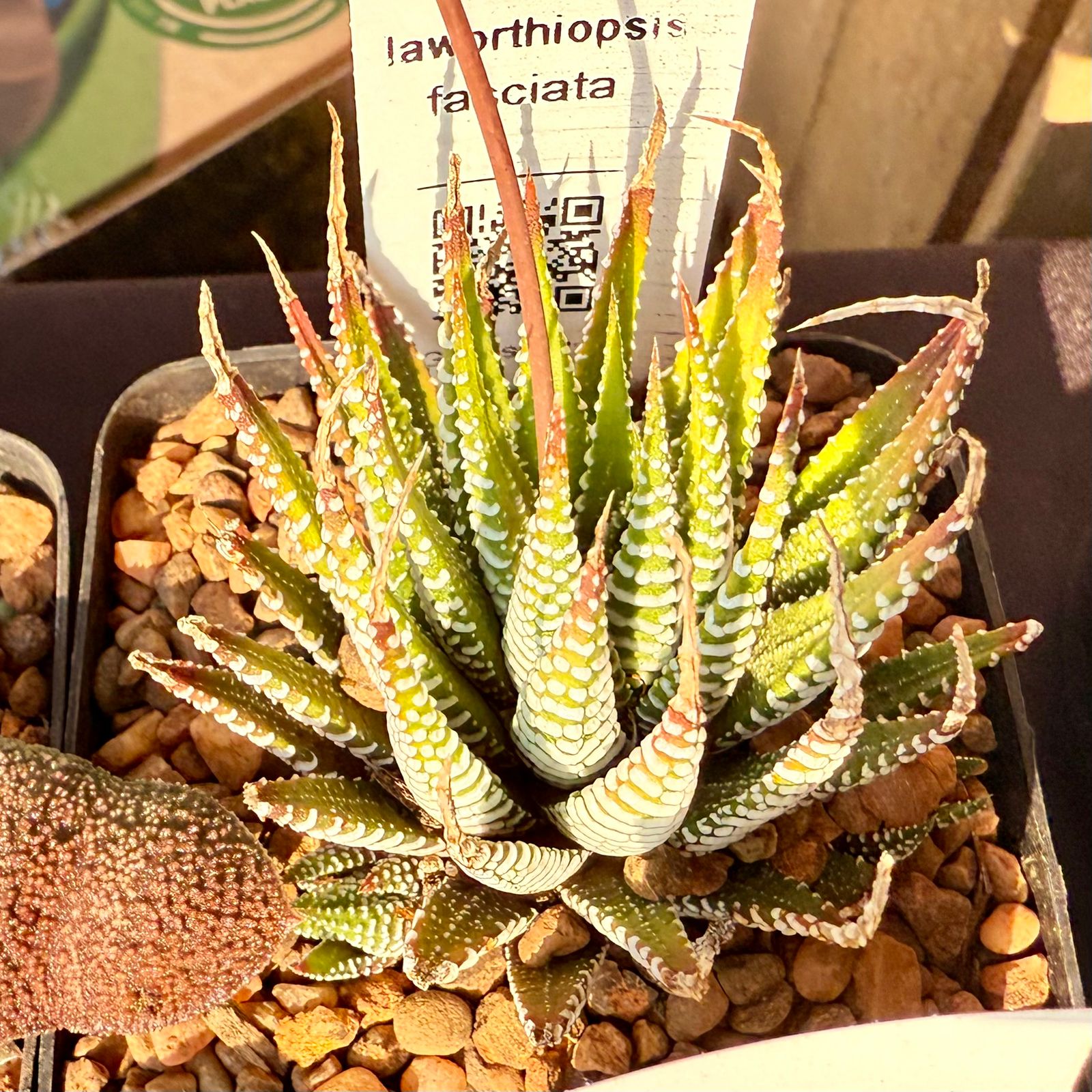
Haworthiopsis fasciata, also known as the Zebra Plant, is a small, rosette-forming succulent that is well-known for its striking, striped leaves. This species has fleshy, dark green leaves that are densely marked with horizontal white stripes or tubercles, giving them the appearance of a zebra’s stripes. The plant typically grows in a compact rosette, with individual leaves reaching about 4 to 6 inches (10-15 cm) long. The leaves are thick, pointed, and slightly curved, and they form tight, dense clusters.
The white bands on the leaves are not only attractive but also help the plant with photosynthesis by reflecting sunlight. As it matures, Haworthiopsis fasciata produces tall, slender flower spikes that emerge from the center of the rosette, bearing small, tubular, white to pale pink flowers. However, its beauty mainly lies in the unique leaf pattern, which makes it a popular ornamental plant.
Native Range:
Haworthiopsis fasciata is native to South Africa, where it can be found in rocky, semi-arid regions. It thrives in well-draining, often sandy or gravelly soils, and has adapted to survive in the hot, dry climate typical of Southern Africa. This species is commonly found in areas with little water, relying on its succulent leaves to store moisture.
Care Tips:
- Light: Haworthiopsis fasciata prefers bright, indirect light but can also tolerate some direct sunlight. Too much direct sun, especially during the hottest parts of the day, can scorch its leaves. It’s ideal for windowsills, balconies, or rooms with plenty of natural light.
- Watering: Like other succulents, it is best to let the soil dry out completely between waterings. Overwatering is one of the main causes of death for this plant, so it’s important to water it sparingly. During the growing season (spring and summer), water once every 1-2 weeks, while reducing watering during the dormant winter months.
- Soil: A well-draining, sandy cactus mix is recommended. If you’re using regular potting soil, make sure to mix it with perlite or sand to improve drainage and prevent water from accumulating in the roots.
- Temperature: Haworthiopsis fasciata thrives in temperatures between 60°F and 80°F (15°C–27°C). It is not frost-tolerant, so it should be brought indoors or moved to a sheltered location if temperatures drop below freezing.
- Fertilizing: Fertilize this plant sparingly. During the growing season, you can feed it once a month with a diluted, balanced fertilizer, but avoid fertilizing in winter when it is dormant.
- Propagation: Haworthiopsis fasciata can be propagated easily through offsets that appear at the base of the plant. These pups can be removed carefully and potted in new soil to grow into independent plants.
Unique and Special:
What makes Haworthiopsis fasciata so special is its striking appearance, especially its unique white banding on dark green leaves, which creates an almost zebra-like pattern. This feature makes it an eye-catching and popular succulent for collectors. Additionally, it is a hardy, low-maintenance plant that is perfect for beginners. Its relatively small size and compact nature also make it an excellent choice for indoor environments, especially in small spaces, such as windowsills or desks. Furthermore, the zebra-like pattern can vary slightly from plant to plant, making each one distinct and adding to the charm of this attractive succulent.
Below are some species we are familiar with…
Haworthiopsis attenuata
Haworthiopsis attenuata bones
Haworthiopsis attenuata colossal bones
Haworthiopsis attenuata enon
Haworthiopsis coarctata
Haworthiopsis colossal coarctata
Haworthiopsis coarctata bellula
Haworthiopsis crocodile skin
Haworthiopsis fasciata
Haworthiopsis fasciata lime
Haworthiopsis limifolia
Haworthiopsis marble queen
Haworthiopsis reinwardtii
Haworthiopsis scabra starkiana