
Haworthiopsis crocodile skin
Haworthiopsis crocodile skin – The Crocodile Skinned Haworthiopsis
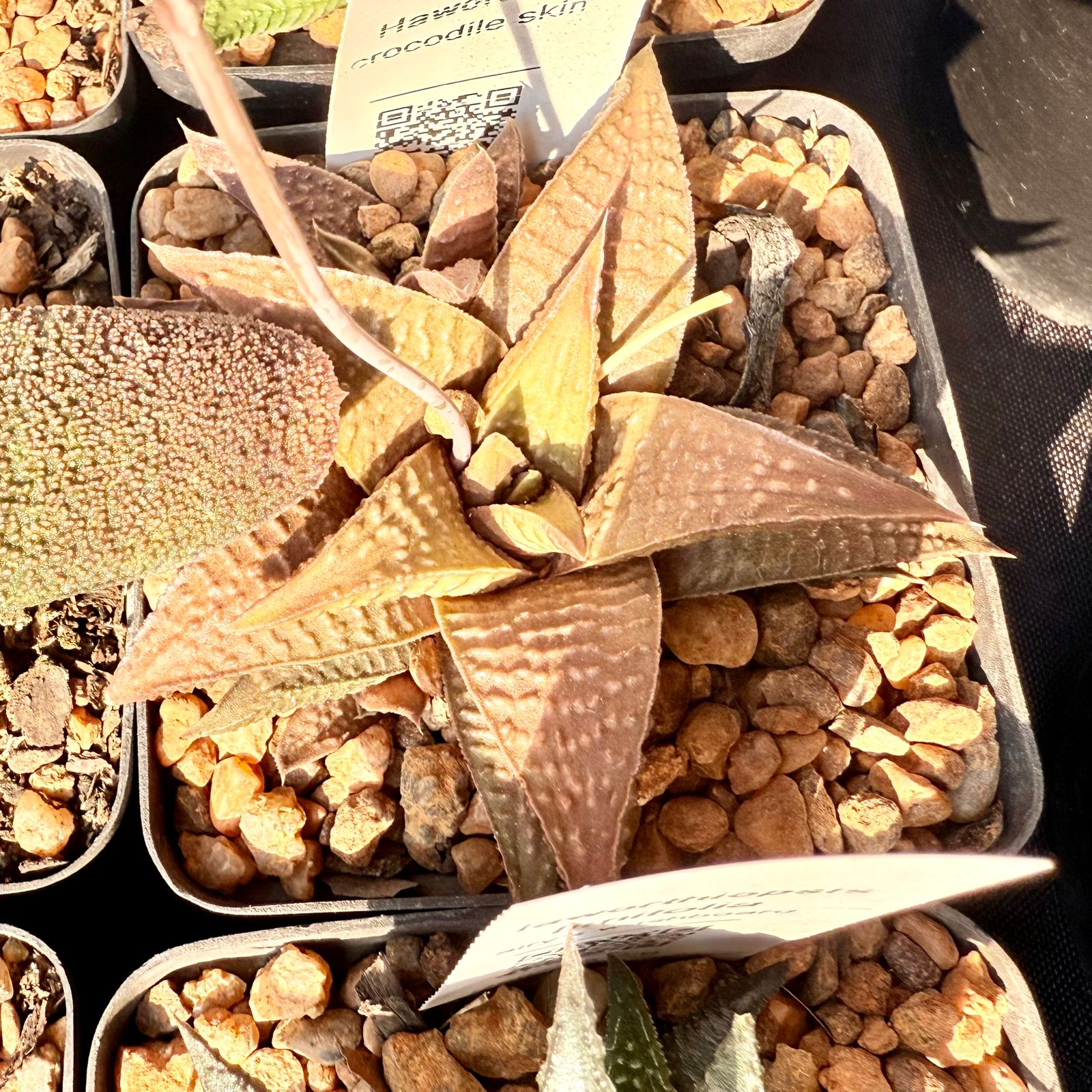
Haworthiopsis ‘Crocodile Skin’ is a striking, slow-growing succulent known for its distinctive textured leaves, which resemble the rough, scaly appearance of crocodile skin. This cultivar is part of the Haworthiopsis genus, a close relative of Haworthia. The plant features fleshy, dark green leaves arranged in a compact rosette, with white, raised tubercles on the surface. These tubercles are more pronounced on the upper surfaces, giving the plant its characteristic rough, scaly texture, which is what gives the cultivar its name.
The leaves are relatively short and thick, forming a tight, rosette structure. This species tends to grow slowly and remains small, usually reaching about 4 to 6 inches (10–15 cm) in diameter at maturity. The plant is highly prized for its unique look, and its leaves have an almost marble-like or reptilian appearance, making it a popular choice for succulent collectors and enthusiasts.
Native Range:
Haworthiopsis ‘Crocodile Skin’ is a cultivar, meaning it is a selected variation rather than a naturally occurring species. However, it is derived from species within the Haworthiopsis genus, which is native to Southern Africa, specifically regions in South Africa and Namibia. These plants thrive in arid, rocky environments, and are adapted to survive in harsh conditions with little water.
Care Tips:
- Light: This cultivar prefers bright, indirect light. While it can tolerate some direct sunlight, it is best placed in an area with filtered light to prevent leaf burn. Too much direct sun, especially in hot climates, can lead to scalding.
- Watering: Haworthiopsis ‘Crocodile Skin’ is drought-tolerant, like many succulents. Water it only when the soil is completely dry. Be cautious about overwatering, as this can lead to root rot. In the winter months, reduce watering significantly, as the plant is less active during this time.
- Soil: Well-draining soil is essential for this succulent. A cactus or succulent potting mix is ideal, but you can improve drainage by adding sand or perlite to the soil mix.
- Temperature: It prefers temperatures between 60°F to 80°F (15°C–27°C) and should be protected from frost. If grown indoors, it is important to keep it in a warm, stable environment.
- Fertilizing: Fertilize sparingly. During the growing season (spring and summer), you can feed it with a diluted, balanced fertilizer once a month, but avoid fertilizing during the winter months when the plant is dormant.
- Propagation: This cultivar can be propagated by offsets, which are small pups that grow around the base of the main plant. Simply remove the offset and plant it in fresh, well-draining soil.
Unique and Special:
The unique, “crocodile-skin” texture of Haworthiopsis ‘Crocodile Skin’ is what makes this cultivar stand out among other succulents. Its leaves are covered in small, raised tubercles, giving it an almost reptilian appearance. This feature is especially noticeable when viewed up close, creating a visually intriguing effect. In addition, the compact size and slow growth of this plant make it ideal for small spaces, windowsills, or terrariums. It’s a low-maintenance, high-impact plant that requires minimal care, making it perfect for both beginner and experienced succulent growers.
Below are some species we are familiar with…
Haworthiopsis attenuata
Haworthiopsis attenuata bones
Haworthiopsis attenuata colossal bones
Haworthiopsis attenuata enon
Haworthiopsis coarctata
Haworthiopsis colossal coarctata
Haworthiopsis coarctata bellula
Haworthiopsis crocodile skin
Haworthiopsis fasciata
Haworthiopsis fasciata lime
Haworthiopsis limifolia
Haworthiopsis marble queen
Haworthiopsis reinwardtii
Haworthiopsis scabra starkiana