
Agave colorata
Agave colorata- The Coastal Agave
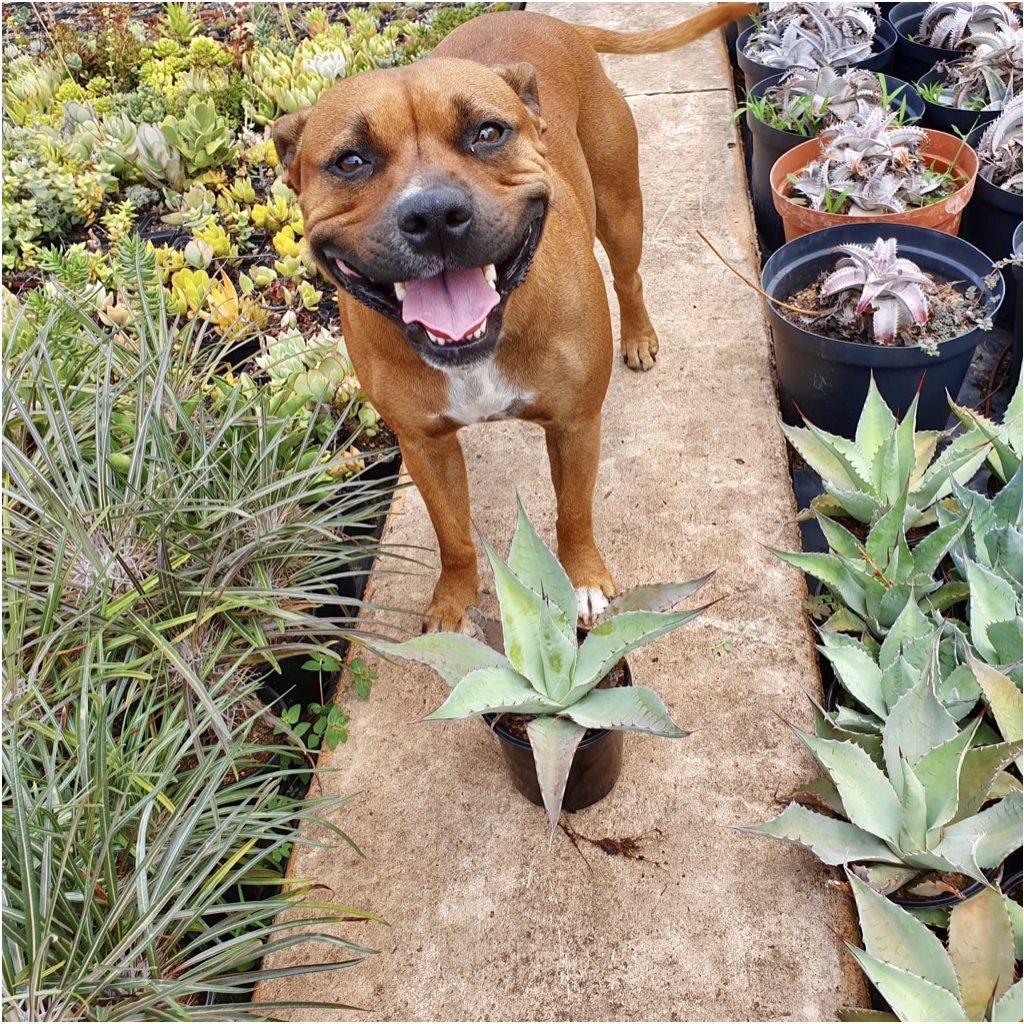
Overview: Agave colorata is a unique and stunning species of agave known for its compact, symmetrical rosette of grayish-blue to greenish-silver leaves. This species is widely appreciated for its striking appearance, slow growth, and tolerance of dry conditions, making it a favorite among succulent and cactus collectors. It is often referred to as the Colorful Agave due to the vibrant hues of its foliage and the bold, architectural form it creates in the landscape.
Common Characteristics:
- Appearance and Growth Habit:
- Agave colorata forms a small to medium-sized rosette, typically growing up to 18-24 inches (45-60 cm) in height and width, making it a manageable size for both ground planting and container use.
- The leaves are thick and succulent, with a distinctive powdery or waxy coating that gives them a slightly blue-gray or silver appearance. The color of the leaves may intensify with exposure to full sun.
- The leaves have smooth edges and terminate in a sharp spine, and while the plant is not covered in spines, the tips are pointed and somewhat sharp.
- The rosette is tight and symmetrical, with curved leaves that arch outward from the center, creating an aesthetically pleasing, globular shape.
- Flowers:
- Agave colorata produces a tall flowering stalk that can reach heights of 4-5 feet (1.2-1.5 meters), rising up from the center of the rosette when the plant is mature, typically after several years.
- The flowers are usually greenish-yellow or cream-colored and grow in dense clusters, attracting pollinators like bees, butterflies, and hummingbirds. As with many agaves, the plant dies after flowering, although it will often produce pups (offsets) around the base before it blooms, ensuring the species continues to thrive.
- Leaves:
- The grayish-blue or silvery leaves have a waxy bloom that helps protect the plant from harsh sunlight and water loss in its native habitat.
- The leaf edges are smooth but can become slightly curved toward the plant’s base, giving the rosette a smooth, sculptural appearance.
- At the tip of each leaf, there is a sharp, dark spine, which serves as a defense mechanism against herbivores.
- Root System:
- Agave colorata has a fibrous root system, which allows it to efficiently absorb moisture while still being resistant to rot when grown in well-draining soils.
Native Range:
Agave colorata is native to Mexico, particularly in the central and northern regions, where it grows in rocky, arid environments with little rainfall. It thrives in desert-like conditions, and its tolerance of dry spells and intense sun makes it well-suited for the harsh conditions of its native habitat.
Care Tips:
- Light:
- This agave thrives in full sun to partial shade. For best results, place it in a location where it can receive at least 6 hours of direct sunlight each day, though it can tolerate some shade, particularly in hotter climates.
- Indoor plants should be placed in a bright, sunny window where they can receive as much sunlight as possible.
- Watering:
- Agave colorata is drought-tolerant and requires minimal watering. Let the soil dry out completely between waterings.
- During the growing season (spring and summer), water only when the soil is dry. In the winter months, water sparingly to avoid rot.
- Overwatering is a common issue with agaves, so ensure that the plant is grown in well-draining soil and never allow water to sit around the roots.
- Soil:
- Use a well-draining cactus or succulent mix for planting Agave colorata. It thrives in sandy, gritty, or rocky soil with excellent drainage.
- If growing in a pot, make sure the container has proper drainage holes to prevent water from collecting at the bottom.
- Temperature:
- This agave prefers warm temperatures and can tolerate heat well. Ideal temperatures are in the range of 70°F to 90°F (21°C to 32°C).
- Agave colorata is not frost-tolerant, so it should be protected from temperatures below 32°F (0°C). If you live in a region with frost or cold winters, consider growing this agave in a pot that can be brought indoors during the colder months.
- Fertilization:
- Agave colorata is a slow-growing plant that does not require frequent fertilization. During the growing season (spring and summer), use a low-nitrogen, balanced fertilizer about once a month to encourage healthy growth.
- Avoid fertilizing in the winter when the plant is dormant.
- Repotting:
- Repot the plant every 2-3 years or when it outgrows its container. Choose a pot that is just slightly larger than the current one, as Agave colorata does not require a lot of space.
- Always use well-draining soil to avoid moisture buildup, which could lead to rot.
- Pruning:
- Agave colorata requires little to no pruning. Remove any dead or damaged leaves by cutting them off at the base of the rosette.
- Handle the plant carefully, as the leaf tips can be sharp, and take precautions when working around the plant to avoid injury.
- Propagation:
- Agave colorata can be propagated by removing the pups (offsets) that grow at the base of the plant. These can be separated carefully from the main plant and repotted into their own containers.
- Allow the pups to callus over for a few days before planting them in well-draining soil.
Unique and Special Aspects:
Agave colorata stands out for its compact, symmetrical rosette and striking coloration, making it an excellent choice for xeriscaping and desert-themed gardens. Its slow-growing nature means that it will remain a manageable size for many years, requiring very little care while offering maximum aesthetic value. Another special feature is its tolerance of dry conditions and minimal watering needs, making it perfect for gardeners looking for low-maintenance, water-wise plants. This species is also highly regarded for its durability and long-lasting appeal, and its silvery-blue foliage and elegant rosette make it a unique addition to any succulent collection or landscape design.
Below are some species we are familiar with…
Agave americana mediopicta alba
Agave applanata creme spike
Agave colorata
Agave confederate rose
Agave creme brulee
Agave filifera
Agave geminiflora
Agave isthmensis
Agave isthmensis variegata
Agave kichiokan
Agave lophantha
Agave ovatifolia
Agave parryi
Agave parryi huachucensis
Agave parryi truncata
Agave stricta
Agave titanota
Agave toumeyana
Agave vilmoriniana
Agave victoriae-reginae
Agave victoriae-reginae picasso
Agave victoriae-reginae snow princess
Agave rum runner